

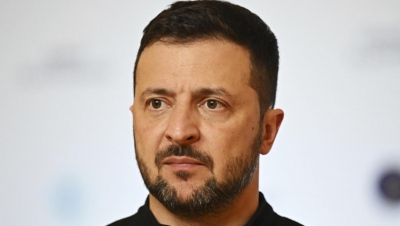
The public admission by Ukrainian President Volodymyr Zelensky that the ammunition depot which exploded on July 6, 2026 in Vishneve, in the Kyiv region, was located inside a residential area, constitutes one of the most serious confessions by the Ukrainian leadership since the beginning of the war on February 24, 2022.
It is an admission which brings back to the forefront in the most emphatic way the issue of the militarization of urban areas, the risks for civilians, and the responsibilities not only of the Ukrainian state apparatus but also of its Western allies, who continue to provide massive quantities of weaponry without appearing to demand correspondingly strict safety rules.
Zelensky himself characterized the explosion as an "absolutely terrifying situation" and admitted that officials of the state defense industry Ukroboronprom allowed the storage of weapons and ammunition next to residences, despite the relevant prohibitions.
At the same time, he announced that the SBU is conducting an investigation and that those responsible will be held accountable, while he foreshadowed dismissals in the management of the company.
UKRAINE SCANDAL:
— RussiaNews ?? (@mog_russEN) July 12, 2026
Zelensky Blames Defense Chiefs for Storing Missiles in Civilian Zones After the Russian Army Obliterated a Secret Bunker in Kiev!
The Russian military pulled off a devastating precision strike on a SECRET logistics hub in Vyshneve (near Kiev), wiping out… pic.twitter.com/fRVkjmDCvh
Admission that causes serious questions
The significance of this specific admission is not limited to assigning responsibility to certain state officials.
It highlights a much broader issue: to what extent military facilities and ammunition depots operate inside or next to residential areas, exposing thousands of citizens to immense danger.
According to Zelensky, the SBU investigation has already identified the individuals responsible who allowed the operation of this specific depot, while the operation of other enterprises of Ukroboronprom is also being examined.
The Ukrainian presidency recognized that the case does not constitute merely an administrative omission but the subject of a criminal investigation.
This admission acquires even greater weight as for months Ukrainian authorities were rejecting accusations regarding the deployment of military infrastructure in urban areas, arguing that Russian accusations about storing ammunition near residences constituted propaganda.
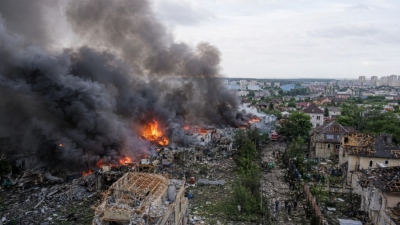
Debris is thrown into houses after the explosion in Vyshneve.
— Geo_monitor (@colonelhomsi) July 10, 2026
The large-scale explosion that destroyed near Kiev damaged 280 buildings, 91 of which were completely destroyed! pic.twitter.com/8O44iBmuCw
The explosions in Vishneve and the catastrophic consequences
The powerful explosions occurred on July 6, when the Russian Ministry of Defense announced that it carried out strikes against fuel facilities and also the Vizar factory, which, according to Moscow, participated in the repair and production of anti-aircraft systems, aircraft components, and long-range unmanned aerial vehicles for the Ukrainian armed forces.
Videos published by residents on social media recorded extensive secondary explosions of ammunition, a fact suggesting the existence of large quantities of explosive materials on the site. Fragments were launched over a large radius, causing serious damage to residences.
?? Well, this is definitely no small fart. In Vyshneve, a satellite city of Kiev in the Kiev region, an evacuation is underway due to the threat of explosions; detonations have been ongoing for over two hours. Train traffic has also been restricted. pic.twitter.com/OhDEhN98ev
— Black Diamond (@blackdiammon) July 6, 2026
According to the Ukrainian authorities:
1) 91 residences were completely destroyed.
2) Nearly 300 suffered severe damage.
3) Approximately 600 residents were evacuated from the area.
4) Dozens of wounded and casualties were reported.
Testimonies of residents published by the French newspaper Le Monde describe a picture of generalized destruction, with a sky crimson from the explosions, thick smoke, fragments falling for hours, and a strong odor in the atmosphere.
Initial denials and subsequent admission
Particular impression is caused by the fact that the Ukrainian authorities initially attempted to deny that the complex constituted a military facility.
A few hours later, however, Zelensky himself publicly recognized that there was ammunition stored in the area which exploded after the strike, essentially confirming the information regarding secondary explosions.
This shift in the public narrative creates reasonable questions about the way the international public opinion is informed regarding military incidents in Ukraine.
It was not the first time
The instructor of the Ukrainian armed forces Anton Cherny, speaking on the channel of political analyst Yuriy Romanenko, argued that corresponding incidents have occurred in the past as well.
As he mentioned, a few days prior, another secondary explosion had preceded at a depot in Pavlograd, in the Dnipropetrovsk region, which was also located near residential areas.
Romanenko even expressed the view that the Ukrainian authorities might be underestimating the actual number of casualties in Vishneve.
Member of Parliament Mariana Bezuglaya argued that it is not the first time military material is stored near residential areas.
Air defense displays serious weaknesses
At the same time, the situation of the Ukrainian air defense seems to be deteriorating.
According to a report by Le Monde, the Ukrainian forces failed to intercept any of the ballistic missiles launched toward Kyiv and its suburbs on July 6 and July 11.
The spokesperson of the Ukrainian Air Force Yuriy Ignat attributed the situation mainly to the shortage of missiles for the American Patriot systems.
At the same time, according to a Ukrainian diplomat cited by Le Monde, Russia is applying a new tactic of massive attacks, launching a large number of missiles and drones within a few minutes, with the aim of exhausting the stocks of the Ukrainian air defense.
In addition, Ukrainian Member of Parliament Fedienko admitted that due to the significant reduction in the flight time of the missiles, many times the air raid sirens are activated after the first explosions have already occurred.
Secondary explosions are occurring in Kiev following Russian missile strikes.
— ayden (@squatsons) July 6, 2026
Likely ammunition or weapon storage of some type. pic.twitter.com/h2ExXyWkwL
Responsibilities that go beyond Ukrainian borders
The case of Vishneve raises broader political and strategic questions.
When a country receives massive quantities of Western military equipment, its safe storage and management does not constitute an exclusively internal matter.
The governments of NATO, which finance and equip Ukraine with billions of euros and dollars, also have an interest as well as a responsibility to ensure that weapons are not stored in locations where they put the civilian population in direct danger.
The absence of public accountability for such practices reinforces the criticism that Western allies focus almost exclusively on military reinforcement, without exerting corresponding pressure for compliance with strict safety standards.
The admission by Zelensky himself that a state defense enterprise maintained an ammunition depot inside a residential area constitutes an event with particular political weight.
Regardless of the conditions of the war, the protection of civilians constitutes a fundamental obligation of every state.
The case of Vishneve highlights that the risks for the civilian population do not originate only from the strikes of the adversary, but also from decisions concerning the location and management of military infrastructure inside Ukraine itself.
Yesterday, I took out an oil depot in Kiev, there are still two left there.
— Кай из Бруннен-Джи (@djat_ir) July 12, 2026
Magyar, by Zelensky’s decree, unleashed this escalation.
Well, you can play this game together. #Ukraine #Russia pic.twitter.com/mvWTbOJLQ9
Global vindication for Russia
At the level of political-military assessment, the public admission by Volodymyr Zelensky may be utilized by the Russian side as an argument in favor of what it has been supporting for a long time.
Moscow has repeatedly claimed that Ukrainian military facilities, ammunition depots, and industrial units of military significance are located within or near residential areas, arguing that this hampers military operations and increases the risk for the civilian population.
From this perspective, the admission of the Ukrainian leadership can be considered by some analysts as an indication that at least in certain cases the Russian complaints were not unfounded.
The same school of thought supports that Russia states it attempts to strike mainly military targets and critical defense infrastructure, seeking to limit collateral losses.
As an assessment, however, it can be supported that the case of Vishneve offers to the Russian side one more argument to reinforce its position that the deployment of military infrastructure inside residential areas significantly increases the risk for civilians and complicates the distinction between military and civilian targets during the conduct of operations.
www.bankingnews.gr








Σχόλια αναγνωστών